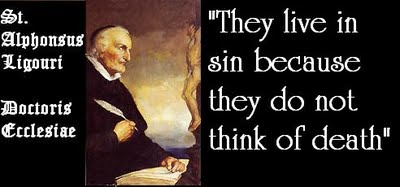
Sunday, January 31, 2010

Wednesday, January 27, 2010
SERMON I. ON THE GENERAL JUDGMENT. By Saint Alphonsus Liguori

"And they shall see the Son of Man coming in the clouds of Heaven with much power and majesty." Matt. xxiv. 30.
At present God is not known, and, therefore, he is as much despised by sinners, as if he could not avenge, whenever he pleases, the injuries offered to him. The wicked”looketh upon the Almighty as if he could do nothing” (Job xxii. 17,) But the Lord has fixed a day, called in the Scriptures "the day of the Lord," on which the Eternal Judge will make known his power and majesty. "The Lord," says the Psalmist, "shall be known when he executeth judgment." (Ps. ix. 17.) On this text St. Bernard writes: ”The Lord, who is now unknown while he seeks mercy, shall be known when he executes justice." (Lib. de xii. Rad.) The prophet Sophonias calls the day of the Lord”a day of wrath a day of tribulation and distress a day of calamity and misery." (i. 15.)
Let us now consider, in the first point, the different appearance of the just and the unjust; in the second, the scrutiny of consciences; and in the third, the sentence pronounced on the elect and on the reprobate.
First Point. On the different appearance of the just and of sinners in the valley of Josaphat.
1. This day shall commence with fire from Heaven, which will burn the earth, all men then living, and all things upon the earth. ”And the earth and the works which are in it shall be burnt up." (2 Pet. iii. 10.) All shall become one heap of ashes.
2 After the death of all men, “the trumpet shall sound, and the dead shall rise again." (1 Cor. xv. 52.) St Jerome used to say: “As often as I consider the day of judgment, I tremble. Whether I eat or drink, or whatever else I do, that terrible trumpet appears to sound in my ears, arise ye dead, and come to judgment" (in Matt, c. v.); and St. Augustine declared, that nothing banished from him earthly thoughts so effectually as the fear of judgment.
3 At the sound of that trumpet the souls of the blessed shall descend from Heaven to be united to the bodies with which they served God on Earth; and the unhappy souls of the damned shall come up from Hell to take possession again of those bodies with which they have offended God. Oh! how different the appearance of the former, compared with that of the latter! The damned shall appear deformed and black, like so many firebrands of Hell; but the just shall shine as the sun (Matt xiii 43) Oh! how great shall then be the happiness of those who have fortified their bodies by works of penance! We may estimate their felicity from the words addressed by St. Peter of Alcantara, after death, to St. Teresa: “O happy penance! which merited for me such glory”
4. After the resurrection, they shall be summoned by the angels to appear in the valley of Josaphat. “Nations, nations, in the valley for destruction for the day of the Lord is near‟‟ (Joel iii 14)” Then the angels shall come and separate the reprobate from the elect, placing the latter on the right, and the former on the left. ”The angels shall go out, and shall separate the wicked from the Just. ”(Matt. xiii 49). Oh! How great will then be the confusion which the unhappy damned shall suffer!. “What think you, ” says the author of the Imperfect Work, “must be the confusion of the impious, when, being separated from the just, they shall be abandoned”(Hom liv.). “This punishment alone” says St. Chrysostom, “would be sufficient to constitute a hell for the wicked”. ”Et si nihil ulterius paterentur, ista sola verecundia sufficerit eis ad poenam," (in Matt, c. xxiv.) The brother shall he separated from the brother, the husband from his wife, the son from the father, etc.
5. But, behold! the heavens are opened the angels come to assist at the general judgment, carrying, as St. Thomas says, the sign of the cross and of the other instruments of the passion of the Redeemer. ”Veniente Domino ad judicium signum crucis, et alia passionis indicia demonstrabunt." (Opusc. ii. 244.) The same may be inferred from the twenty-fourth chapter of St. Matthew: ”And then shall appear the sign of the Son of Man in Heaven; and then shall all the tribes of the earth mourn." (xxiv. 30.) Sinners shall weep at the sign of the cross; for, as St. Chrysostom says, the nails will complain of them the wounds and the cross of Jesus Christ will speak against them. ”Clavi de te conquerentur, cicatrices contra et loquentur, crux Christi contra te perorabit." (Hom, xx., in Matt.)
6. Most holy Mary, the queen of saints and angels, shall come to assist at the last judgment; and lastly, the Eternal Judge shall appear in the clouds, full of splendour and majesty. “And they shall see the Son of Man coming in the clouds of Heaven with much power and majesty." (Matt. xxiv. 30.) Oh! how great shall be the agony of the reprobate at the sight of the Judge! "At their presence” says the Prophet Joel, "the people shall be in grievous pains." (Joel ii. 6.) According to St. Jerome, the presence of Jesus Christ will give the reprobate more pain than Hell itself. “It would," he says, ”be easier for the damned to bear the torments of Hell than the presence of the Lord." Hence, on that day, the wicked shall, according to St. John, call on the mountains to fall on them and to hide them from the sight of the judge. "And they shall say to the mountains and the rocks: Fall upon us, and hide us from the face of Him that sitteth on the throne, and from the wrath of the Lamb." (Apoc. vi. 16.)
Second Point. The scrutiny of conscience.
7. "The judgment sat, and the books were opened. ”(Dan. vii. 10.) The books of conscience are opened, and the judgment commences. The Apostle says, that the Lord”will bring to light the hidden things of darkness." (1 Cor. iv. 5.) And, by the mouth of his prophet, Jesus Christ has said: ”I will search Jerusalem with lamps." (Soph. i. 12.) The light of the lamp reveals all that is hidden.
8. ”A judgment," says St. Chrysostom, ”terrible to sinners, but desirable and sweet to the just." (Hom. iii. de Dav.) The last judgment shall fill sinners with terror, but will be a source of joy and sweetness to the elect; for God will then give praise to each one according to his works. (1 Cor. iv. 5.) The Apostle tells us that on that day the just will be raised above the clouds to be united to the angels, and to increase the number of those who pay homage to the Lord. ”We shall be taken up together with them in the clouds to meet Christ, into the air." (I Thess. iv. 16.)
9. Worldlings now regard as fools the saints who led mortified and humble lives; but then they shall confess their own folly, and say: "We fools esteemed their life madness, and their end without honour. Behold how they are numbered among the children of God, and their lot is among the saints." (Wis. v. 4, 5.) In this world, the rich and the noble are called happy; but true happiness consists in a life of sanctity. Rejoice, ye souls who live in tribulation;”our sorrow shall be turned into joy." (John xvi. 20.) In the valley of Josaphat you shall be seated on thrones of glory.
10. But the reprobate, like goats destined for the slaughter, shall be placed on the left, to await their last condemnation. ”Judicii tempus," says St. Chrysostom, ”misericordiam non recipit." On the day of judgment there is no hope of mercy for poor sinners. “Magna," says St. Augustine, "jam est poena peccati, metum et memoriam divini perdidisse judicii." (Serm. xx. de Temp.) The greatest punishment of sin in those who live in enmity with God, is to lose the fear and remembrance of the divine judgment. Continue, continue, says the Apostle, to live obstinately in sin; but in proportion to your obstinacy, you shall have accumulated for the day of judgment a treasure of the wrath of God “But according to thy hardness and impenitent heart , thou treasurest up to thyself wrath against the day of wrath” (Rom ii. 5)
11. Then sinners will not be able to hide themselves but, with insufferable pain, they shall be compelled to appear in judgment. "To lie hid” says St. Anselm, “will be impossible to appear will be intolerable." The devils will perform their office of accusers, and as St. Augustine says, will say to the Judge: “Most just God, declare him to be mine, who was unwilling to be yours. ” The witnesses against the wicked shall be first, their own conscience. "Their conscience bearing witness to them, ”(Rom. ii. 15); secondly, the very walls of the house in which they sinned shall cry out against them”The stone shall cry out of the wall," (Hab. ii 11); thirdly, the Judge himself will say "I am the judge and the witness, saith the Lord." (Jer. xxix 23 ) Hence, according to St. Augustine, "He who is now the witness of .your life, shall be the judge of your cause. ” (Lib. x. de Chord., c. ii.) To Christians particularly he will say: "Woe to thee, Corozain, woe to thee, Bethsaida; for if in Tyre and Sidon had been wrought the miracles that have been wrought in you, they had long ago done penance in sackcloth and ashes”(Matt. xi. 21.) Christians, he will say, if the graces which I have bestowed on you had been given to the Turks or to the Pagans, they would have done penance for their sins; but you have ceased to sin only with your death. He shall then manifest to all men their most hidden crimes. "I will discover thy shame to thy face. ” (Nahum iii. 5.) He will expose to view all their secret impurities, injustices, and cruelties. ”I will set all thy abominations against thee”(Ezech. vii. 3.) Each of the damned shall carry his sins written on his forehead.
12. What excuses can save the wicked on that day? Ah! they can offer no excuses. ”All iniquity shall stop her mouth." (Ps. cvi. 42.) Their very sins shall close the mouth of the reprobate, so that they will not have courage to excuse themselves. They shall pronounce their own condemnation.
Third Point. Sentence of the elect, and of the reprobate.
13. St. Bernard says, that the sentence of the elect, and their destiny to eternal glory, shall be first declared, that the pains of the reprobate may be increased by the sight of what they lost. ”Prius pronunciabitur sententia electis ut acrius (reprobi) doleant videntes quid amiserunt." (Ser. viii., in Ps. xc.) Jesus Christ, then, shall first turn to the elect, and with a serene countenance shall say: "Come, ye blessed of my Father, possess the kingdom prepared for you from the foundation of the world. ”(Matt. xxv. 34.) He will then bless all the tears shed through sorrow for their sins, and all their good works, their prayers, mortifications, and communions; above all, he will bless for them the pains of his passion and the blood shed for their salvation. And, after these benedictions, the elect, singing alleluias, shall enter Paradise to praise and love God eternity.
14. The Judge shall then turn to the reprobate, and shall pronounce the sentence of their condemnation in these words . ”Depart from me, you cursed, into everlasting fire." (Matt. xxv. 41 ) They shall then be forever accursed, separated from God, and sent to burn for ever in the fire of hell. “And these shall go into everlasting punishment: but the just into life everlasting. ” (Matt. xxv. 46.)
15. After this sentence, the wicked shall, according to St. Ephrem, be compelled to take leave for ever of their relatives, of Paradise, of the saints, and of Mary the divine Mother. "Farewell, ye just! Farewell, O cross I Farewell, Paradise! Farewell, fathers and brothers: we shall never see you again! Farewell, O Mary, mother of God!”(St. Eph. de variis serm. inf.) Then a great pit shall open in the middle of the valley: the unhappy damned shall be cast into it, and shall see those doors shut which shall never again be opened. O accursed sin! to what a miserable end will you one day conduct so many souls redeemed by the blood of Jesus Christ. O unhappy souls! for whom is prepared such a melancholy end. But, brethren, have confidence. Jesus Christ is now a Father, and not judge. He is ready to pardon all who repent. Let us then instantly ask pardon from him.
Monday, January 25, 2010
Maxims for the Direction of a Soul that Desires to Obtain Perfection in the Love of Jesus Christ by Saint Alphonsus Liguori
1. To desire ardently to increase in the love of Jesus Christ.
2. Often to make acts of love towards Jesus Christ. Immediately on waking, and before going to sleep, to make an act of love, seeking always to unite your own will to the will of Jesus Christ.
3. Often to meditate on his Passion.
4. Always to ask Jesus Christ for his love.
5. To communicate often, and many times in the day to make spiritual Communions.
6. Often to visit the Most Holy Sacrament.
7. Every morning to receive from the hands of Jesus Christ himself your own cross.
8. To desire Paradise and death, in order to be able to love Jesus Christ perfectly and for all eternity.
9. Often to speak of the love of Jesus Christ.
10. To accept contradictions for the sake of Jesus Christ.
11. To rejoice in the happiness of God.
12. To do that which is most pleasing to Jesus Christ, and not to refuse him anything that is agreeable to him.
13. To desire and to endeavor that all should love Jesus Christ.
14. To pray always for sinners and for the souls in purgatory.
15. To drive from your heart every affection that does not belong to Jesus Christ.
16. Always to have recourse to the most holy Mary, that she may obtain for us the love of Jesus Christ.
17. To honor Mary in order to please Jesus Christ.
18. To seek to please Jesus Christ in all your actions.
19. To offer yourself to Jesus Christ to suffer any pain for his love.
20 To be always determined to die rather than commit a willful venial sin.
21. To suffer crosses patiently, saying, "Thus it pleases Jesus Christ."
22. To renounce your own pleasures for the love of Jesus Christ.
23. To pray as much as possible.
24. To practice all the mortifications that obedience permits.
25. To do all your spiritual exercises as if it were for the last time.
26. To persevere in good works in the time of aridity.
27. Not to do nor yet to leave undone anything through human respect.
28. Not to complain in sickness.
29. To love solitude, to be able to converse alone with Jesus Christ.
30. To drive away melancholy.
37. Often to recommend yourself to those persons who love Jesus Christ.
32. In temptation, to have recourse to Jesus crucified, and to Mary in her sorrows.
33. To trust entirely in the Passion of Jesus Christ.
34. After committing a fault, not to be discouraged, but to repent and resolve to amend.
35. To do good to those who do evil.
36. To speak well of all, and to excuse the intention when you cannot defend the action.
37. To help your neighbor as much as you can.
38. Neither to say nor to do anything that might vex him. And if you have been wanting in charity, to ask his pardon and speak kindly to him.
39. Always to speak with mildness and in a low tone.
40. To offer to Jesus Christ all the contempt and persecution that you meet with.
41. To look upon [religious] Superiors as the representatives of Jesus Christ.
42. To obey without answering and without repugnance, and not to seek your own satisfaction in anything.
43. To like the lowest employments.
44. To like the poorest things.
45. Not to speak either good or evil of yourself.
46. To humble yourself even towards inferiors.
47. Not to excuse yourself when you are reproved.
48. Not to defend yourself when found fault with.
49. To be silent when you are disquieted.
50. Always to renew your determination of becoming a saint, saying, "My Jesus, I desire to be all Yours, and You must be all mine."
Source: The Incarnation, Birth, and Infancy of Jesus Christ 1927
St Alphonsus Liguori, Pray for us! Sancta Alphonsus Liguori, Ora Pro Nobis! Amen
Archdiocese of Hanoi condemns savage beating of Redemptorist brother
.- The Archdiocese of Hanoi has condemned local government attacks against Catholics at Dong Chiem parish, including the “savage” and “brutal” beating of a Redemptorist brother by police.
The attack is the latest incident near Dong Chiem parish, where local authorities blew up a cemetery’s Crucifix in the early morning of Jan. 6.
On Wednesday, police “brutally” beat Redemptorist Br. Anthony Nguyen Van Tang so severely that he lost consciousness, the Archdiocese said in a statement.
The statement, signed by vice-chancellor Fr. Long Le Trong Cung, reported that a group of Priests and religious had wanted to visit Dong Chiem after they learned of escalating violence against parishioners and Priests.
As of Jan. 20, the parish was “completely besieged” and police at checkpoints prohibited anyone from entering, J.B. An Dang tells CNA.
The delegation from the archdiocese was stopped by police at Xay Bridge, about one-third of a mile from the Church. Hanoi Redemptorists spokesman Fr. Peter Nguyen Van Khai told the Vietnam Redemptorist provincial Superior that four of the five policemen there attacked Br. Anthony Nguyen and a layman.
“The lay man was slightly injured, but Br. Anthony Nguyen suffered serious injuries on the head, lips and eyes,” reported Fr. Peter Nguyen, who said the brother was “savagely assaulted” and lost consciousness.
“The shirt of the lay man, and the one of a motorbike driver, who helped to transport him to a nearby parish, were soaked with the Redemptorist's blood,” he said.
Locals reportedly recognized the attackers as “police from [the] inner city of Hanoi.”
The Archdiocese of Hanoi expressed great concern about the violent situation at Dong Chiem, J.B. An Dang reports. It said “hundreds” of anti-riot police, militiamen and plainclothes police are deployed in the area to bar passage to and from the parish.
The Archdiocese reported that Dong Chiem’s pastor, Fr. Nguyen Van Huu, and the assistant Priest, Fr. Nguyen Van Lien, have been repeatedly summoned and interrogated by police.
“Parishioners have been subjected [to] beatings and massive arrests,” it continued, listing the names of 16 detainees.
Additionally, parishioners are being blasted by threatening messages on public loudspeakers which broadcast all day long.
The Archdiocese of Hanoi has asked all Catholics to “fervently pray” for Priests and parishioners of the parish, especially for those who have been jailed and attacked “in this time of difficulty.” It also sought prayers for respect for human rights.
J.B. An Dang tells CNA that parishes have been asked to sing the “Peace Prayer of St. Francis of Assisi” at the end of every Mass until the persecution ends and justice is restored.
Let us offer up prayers for our persecuted brethren in Vietnam.
Thursday, January 21, 2010
The Last Will and Testament of Louis XVI
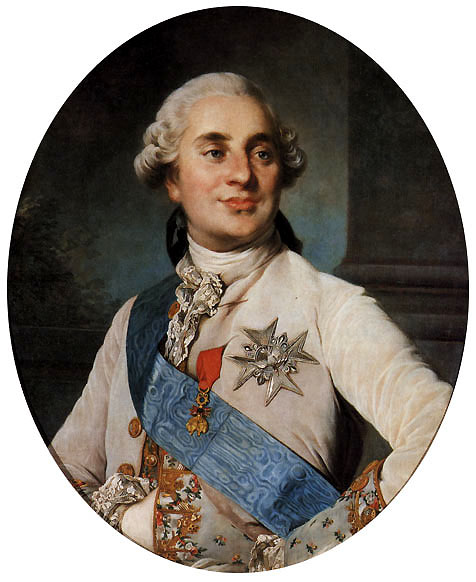
January 21 marked the anniversary of the regicide of Louis XVI, King of France, by the revolutionary authorities. Here is his last will and testament, written a month previous on Christmas Day.
In the name of the Very holy Trinity, Father, Son and Holy Ghost.
To-day, the 25th day of December, 1792, I, Louis XVI King of France, being for more than four months imprisoned with my family in the tower of the Temple at Paris, by those who were my subjects, and deprived of all communication whatsoever, even with my family, since the eleventh instant; moreover, involved in a trial the end of which it is impossible to foresee, on account of the passions of men, and for which one can find neither pretext nor means in any existing law, and having no other witnesses, for my thoughts than God to whom I can address myself, I hereby declare, in His presence, my last wishes and feelings.
I leave my soul to God, my creator; I pray Him to receive it in His mercy, not to judge it according to its merits but according to those of Our Lord Jesus Christ who has offered Himself as a sacrifice to God His Father for us other men, no matter how hardened, and for me first.
I die in communion with our Holy Mother, the Catholic, Apostolic, Roman Church, which holds authority by an uninterrupted succession, from St. Peter, to whom Jesus Christ entrusted it; I believe firmly and I confess all that is contained in the creed and the commandments of God and the Church, the sacraments and the mysteries, those which the Catholic Church teaches and has always taught. I never pretend to set myself up as a judge of the various way of expounding the dogma which rend the church of Jesus Christ, but I agree and will always agree, if God grant me life the decisions which the ecclesiastical superiors of the Holy Catholic Church give and will always give, in conformity with the disciplines which the Church has followed since Jesus Christ.
I pity with all my heart our brothers who may be in error but I do not claim to judge them, and I do not love them less in Christ, as our Christian charity teaches us, and I pray to God to pardon all my sins. I have sought scrupulously to know them, to detest them and to humiliate myself in His presence. Not being able to obtain the ministration of a Catholic priest, I pray God to receive the confession which I feel in having put my name (although this was against my will) to acts which might be contrary to the discipline and the belief of the Catholic church, to which I have always remained sincerely attached. I pray God to receive my firm resolution, if He grants me life, to have the ministrations of a Catholic priest, as soon as I can, in order to confess my sins and to receive the sacrament of penance.
I beg all those whom I might have offended inadvertently (for I do not recall having knowingly offended any one), or those whom I may have given bad examples or scandals, to pardon the evil which they believe I could have done them.
I beseech those who have the kindness to join their prayers to mine, to obtain pardon from God for my sins.
I pardon with all my heart those who made themselves my enemies, without my have given them any cause, and I pray God to pardon them, as well as those who, through false or misunderstood zeal, did me much harm.
I commend to God my wife and my children, my sister, my aunts, my brothers, and all those who are attached to me by ties of blood or by whatever other means. I pray God particularly to cast eyes of compassion upon my wife, my children, and my sister, who suffered with me for so long a time, to sustain them with His mercy if they shall lose me, and as long as they remain in his mortal world.
I commend my children to my wife; I have never doubted her maternal tenderness for them. I enjoin her above all to make them good Christians and honest individuals; to make them view the grandeurs of this world (if they are condemned to experience them) as very dangerous and transient goods, and turn their attention towards the one solid and enduring glory, eternity. I beseech my sister to kindly continue her tenderness for my children and to take the place of a mother, should they have the misfortune of losing theirs.
I beg my wife to forgive all the pain which she suffered for me, and the sorrows which I may have caused her in the course of our union; and she may feel sure that I hold nothing against her, if she has anything with which to reproach herself.
I most warmly enjoin my children that, after what they owe to God, which should come first, they should remain forever united among themselves, submissive and obedient to their mother, and grateful for all the care and trouble which she has taken with them, as well as in memory of me. I beg them to regard my sister as their second mother.
I exhort my son, should he have the misfortune of becoming king, to remember he owes himself wholly to the happiness of his fellow citizens; that he should forget all hates and all grudges, particularly those connected with the misfortunes and sorrows which I am experiencing; that he can make the people happy only by ruling according to laws: but at the same time to remember that a king cannot make himself respected and do the good that is in his heart unless he has the necessary authority, and that otherwise, being tangled up in his activities and not inspiring respect, he is more harmful than useful.
I exhort my son to care for all the persons who are attached to me, as much as his circumstances will allow, to remember that it is a sacred debt which I have contracted towards the children and relatives of those who have perished for me and also those who are wretched for my sake. I know that there are many persons, among those who were near me, who did not conduct themselves towards me as they should have and who have even shown ingratitude, but I pardon them (often in moments of trouble and turmoil one is not master of oneself), and I beg my son that, if he finds an occasion, he should think only of their misfortunes.
I should have wanted here to show my gratitude to those who have given me a true and disinterested affection; if, on the one hand, I was keenly hurt by the ingratitude and disloyalty of those to whom I have always shown kindness, as well as to their relatives and friends, on the other hand I have had the consolation of seeing the affection and voluntary interest which many persons have shown me. I beg them to receive my thanks.
In the situation in which matters still are, I fear to compromise them if I should speak more explicitly, but I especially enjoin my son to seek occasion to recognize them.
I should, nevertheless, consider it a calumny on the nation if I did not openly recommend to my son MM. De Chamilly and Hue, whose genuine attachment for me led them to imprison themselves with me in this sad abode. I also recommend Clery, for whose attentiveness I have nothing but praise ever since he has been with me. Since it is he who has remained with me until the end, I beg the gentlemen of the commune to hand over to him my clothes, my books, my watch, my purse, and all other small effects which have been deposited with the council of the commune.
I pardon again very readily those who guard me, the ill treatment and the vexations which they thought it necessary to impose upon me. I found a few sensitive and compassionate souls among them – may they in their hearts enjoy the tranquillity which their way of thinking gives them.
I beg MM. De Malesherbes, Tronchet and De Seze to receive all my thanks and the expressions of my feelings for all the cares and troubles they took for me.
I finish by declaring before God, and ready to appear before Him, that I do not reproach myself with any of the crimes with which I am charged.
Made in duplicate in the Tower of the Temple, the 25th of December 1792.
Thursday, January 14, 2010
Happy is he who Desires Nothing but God by Father Eugene Grimm C.Ss.R
Taken from Pious Reflections
Blessed are the poor in spirit, for theirs is the kingdom of heaven.1 By “the poor in spirit” is meant those who are poor in earthly desires, and desire nothing but God. These are poor in desires, but not without affection, because they live contented even in this life; and, therefore, the Lord does not say, “Theirs will be the kingdom of heaven,” but “theirs is,” because even in this life they are rich in spiritual blessings which they receive from God; and thus, however poor they are in temporal goods, they live content with their condition. They are different from the rich in earthly desires, who, in the present life, whatever riches they possess, are always poor, and live discontented; for the good things of this life do not satisfy our thirst, however much they are increased; wherefore, these persons are never contented, never attaining to the acquisition of what they desire.
In order to enrich us with true riches, Jesus Christ chose to be a poor man, as the Apostle writes, For your sakes He became poor, that by His poverty ye might become rich.2 He chose to be poor in order to teach us by his example to despise earthly blessings; and thus to enrich us with heavenly blessings, which are infinitely more precious, and which last forever. Wherefore he declared that whoever did not renounce every species of attachment to this earth could not be his true disciple.
Happy he who desires nothing but God, and can say, with St. Paulinus, “Let the rich have their riches, kings their kingdoms; Christ is my wealth and my kingdom.”3 Let us rest assured that God alone can content us, but he does not fully content any but those souls which love him with a whole heart. And what place can the love of God find in a heart that is full of this earth? Such people may go often to communion, and pay visits to the Blessed Sacrament; but, because this earth is in their hearts, God cannot wholly possess them, and enrich them as he would.
Many souls lament that in their meditations and communions, and in their other most devout exercises, they do not find God. To such St. Teresa said, “Detach thy heart from all creatures, and thou shalt find God.” Let us strip ourselves of every affection that tends to earthly things, and especially of our own will; let us give to God our whole will, without reserve, and say to him, “Lord, do Thou dispose of me, and of all I have, as Thou wilt; I desire nothing but what Thou desirest, and I know that what Thou wilt is the best for me. Grant me, then, that I may ever love Thee, and I desire nothing more.”
The only means for detaching ourselves from creatures is to acquire a great love for God. If the love of God does not go so far as to obtain the mastery over our own will, we shall never attain to being saints. The means for acquiring this ruling love is devout prayer. Let us constantly pray to God to give us his love, that we may thus find ourselves detached from every created thing. Divine love is a thief, which, in a holy way, robs us of all earthly affections, and causes us to say, “What other thing do I desire but Thee alone, O God of my heart!”
Love is strong as death.4 This means that as there is no power that resists death, so there is nothing, even of things most invincible, that can resist the love of God. Love conquers everything. With the love of God the martyrs conquered the fiercest torments and the most agonizing deaths.
Oh, happy indeed is he who can say with David, What have I in heaven, and what have I desired upon earth, but Thee, O God of my heart, and my portion forever! What else can I desire in this life and in eternity, but Thee alone, O my God? Let others find the good things they choose; be Thou, O God of my heart, my only good; be Thou all my peace.
In what peril does the soul stand of losing God and perishing when it has not attained to the giving itself wholly to God; while he who has truly given himself altogether to God can rest secure of never leaving him, because the Lord is truly merciful and faithful to every one who gives himself to him without reserve. But why is it that some persons, who began by living a holy life, afterwards fall so grievously, that they leave us little hope of their salvation? Why, indeed, is this? I answer, that they had not given themselves wholly to God; and this their fall is the proof of it.
O my God, and my true lover! suffer it not that my soul, which was created to love Thee, should love any thing apart from Thee, and should not wholly belong to Thee, who hast purchased me with Thy blood. O my Jesus! how is it possible that, after having known the love which Thou hast borne to me, I can love anything apart from Thee? Draw me continually within Thy heart; make me forget everything that I may neither seek nor sigh after anything but Thy love. O my Jesus! in Thee I trust. O Mary, Mother of God! in thee is my hope; detach me from the love of everything that is not of God, that he may be the one object of all my affections, and of my eternal happiness.
1“Beati pauperes spiritu, quoniam ipsorum est regnum cœlorum.” -- Matt. v. 3.
2“Propter vos egenus factus est, ut illius inopia vos divites essetis.” -- 2 Cor. viii. 9.
3“Sibi habeant divitias suas divites, sibi regna sua reges; nobis gloria et possessio et regnum Christus est.” -- Ep. ad Aprum.
4“Fortis est ut mors dilectio.” -- Cant. viii. 6.
Blessed are the poor in spirit, for theirs is the kingdom of heaven.1 By “the poor in spirit” is meant those who are poor in earthly desires, and desire nothing but God. These are poor in desires, but not without affection, because they live contented even in this life; and, therefore, the Lord does not say, “Theirs will be the kingdom of heaven,” but “theirs is,” because even in this life they are rich in spiritual blessings which they receive from God; and thus, however poor they are in temporal goods, they live content with their condition. They are different from the rich in earthly desires, who, in the present life, whatever riches they possess, are always poor, and live discontented; for the good things of this life do not satisfy our thirst, however much they are increased; wherefore, these persons are never contented, never attaining to the acquisition of what they desire.
In order to enrich us with true riches, Jesus Christ chose to be a poor man, as the Apostle writes, For your sakes He became poor, that by His poverty ye might become rich.2 He chose to be poor in order to teach us by his example to despise earthly blessings; and thus to enrich us with heavenly blessings, which are infinitely more precious, and which last forever. Wherefore he declared that whoever did not renounce every species of attachment to this earth could not be his true disciple.
Happy he who desires nothing but God, and can say, with St. Paulinus, “Let the rich have their riches, kings their kingdoms; Christ is my wealth and my kingdom.”3 Let us rest assured that God alone can content us, but he does not fully content any but those souls which love him with a whole heart. And what place can the love of God find in a heart that is full of this earth? Such people may go often to communion, and pay visits to the Blessed Sacrament; but, because this earth is in their hearts, God cannot wholly possess them, and enrich them as he would.
Many souls lament that in their meditations and communions, and in their other most devout exercises, they do not find God. To such St. Teresa said, “Detach thy heart from all creatures, and thou shalt find God.” Let us strip ourselves of every affection that tends to earthly things, and especially of our own will; let us give to God our whole will, without reserve, and say to him, “Lord, do Thou dispose of me, and of all I have, as Thou wilt; I desire nothing but what Thou desirest, and I know that what Thou wilt is the best for me. Grant me, then, that I may ever love Thee, and I desire nothing more.”
The only means for detaching ourselves from creatures is to acquire a great love for God. If the love of God does not go so far as to obtain the mastery over our own will, we shall never attain to being saints. The means for acquiring this ruling love is devout prayer. Let us constantly pray to God to give us his love, that we may thus find ourselves detached from every created thing. Divine love is a thief, which, in a holy way, robs us of all earthly affections, and causes us to say, “What other thing do I desire but Thee alone, O God of my heart!”
Love is strong as death.4 This means that as there is no power that resists death, so there is nothing, even of things most invincible, that can resist the love of God. Love conquers everything. With the love of God the martyrs conquered the fiercest torments and the most agonizing deaths.
Oh, happy indeed is he who can say with David, What have I in heaven, and what have I desired upon earth, but Thee, O God of my heart, and my portion forever! What else can I desire in this life and in eternity, but Thee alone, O my God? Let others find the good things they choose; be Thou, O God of my heart, my only good; be Thou all my peace.
In what peril does the soul stand of losing God and perishing when it has not attained to the giving itself wholly to God; while he who has truly given himself altogether to God can rest secure of never leaving him, because the Lord is truly merciful and faithful to every one who gives himself to him without reserve. But why is it that some persons, who began by living a holy life, afterwards fall so grievously, that they leave us little hope of their salvation? Why, indeed, is this? I answer, that they had not given themselves wholly to God; and this their fall is the proof of it.
O my God, and my true lover! suffer it not that my soul, which was created to love Thee, should love any thing apart from Thee, and should not wholly belong to Thee, who hast purchased me with Thy blood. O my Jesus! how is it possible that, after having known the love which Thou hast borne to me, I can love anything apart from Thee? Draw me continually within Thy heart; make me forget everything that I may neither seek nor sigh after anything but Thy love. O my Jesus! in Thee I trust. O Mary, Mother of God! in thee is my hope; detach me from the love of everything that is not of God, that he may be the one object of all my affections, and of my eternal happiness.
1“Beati pauperes spiritu, quoniam ipsorum est regnum cœlorum.” -- Matt. v. 3.
2“Propter vos egenus factus est, ut illius inopia vos divites essetis.” -- 2 Cor. viii. 9.
3“Sibi habeant divitias suas divites, sibi regna sua reges; nobis gloria et possessio et regnum Christus est.” -- Ep. ad Aprum.
4“Fortis est ut mors dilectio.” -- Cant. viii. 6.
Wednesday, January 13, 2010
The Affair of Eternal Salvation by Father Eugene Grimm C.Ss.R
Taken from Pious Reflections
The business of our eternal salvation is for us that affair which is not only the most important, but the only thing that ought to trouble us; because, if this goes wrong, all is lost. One thought upon eternity, well weighed, is enough to make a saint. The great servant of God, F. Vincenzo Carafa, was wont to say that if all men thought with a living faith upon the eternity of another life, the world would become a desert, for no one would attend any more to the affairs of this life.
Oh, that all had ever before their eyes the great truth taught us by Jesus Christ! What doth it profit a man, if he gain the whole world, and suffer the loss of his own soul?1 This truth has taught many a man to leave the world; many noble virgins, and even those of royal blood, to shut themselves up in a cloister; many anchorites to live in deserts, and many martyrs to give their lives for the faith; because they considered that if they lost their souls, all the good things of the world would profit them nothing in the eternal state.
Therefore the Apostle wrote to his disciples: We entreat you, brethren, that ye attend to your own business.2 And of what business did St. Paul speak? He spoke of that business which, if it fail, implies that we lose the eternal kingdom of Paradise, and are cast into an abyss of torments that never end. It is an affair of eternal punishments, and of the loss of the heavenly kingdom, says St. John Chrysostom.3
St. Philip Neri, therefore, had good reason for calling all those persons mad who bestow pains in this life for gaining riches and honors, and give little heed to the salvation of the soul. “All such,” said the venerable John Avila, “deserve to be shut up in an asylum for lunatics.” How can this be? This great servant of God meant to say, “You believe that there is an eternity of joys for those who love God, and an eternity of pains for those who offend him; and do you offend him?”
Every loss of property, of reputation, of relatives, of health, can be repaired in this life, at least by a good death, and by the acquisition of eternal life, as it happened to the holy martyrs; but for what good things of the world, with fortune even the greatest, can be given the loss of the soul? What shall a man give in exchange for his soul?4
He that dies in the wrath of God, and loses his soul, loses with this every hope of repairing his ruin. To the wicked, when he is dead, there is no hope more.5 O God! if the doctrine of eternal life were but a simple, doubtful opinion of divines, we ought surely to give all our care for gaining a happy eternity, and avoiding a miserable one. But no; it is not a doubtful thing; it is certain, it is of faith, that we must come to one or the other.
But what do we see? Every one who has faith, and thinks upon this truth, says, “So it is we must attend to the salvation of the soul;” but few are they who truly give heed to it. They devote themselves with all their energies to win this cause, or to obtain this situation, but lay aside the care of eternal salvation. “Truly, it is the greatest of errors to neglect the business of eternal salvation,”6 said St. Eucherius; it is an error that exceeds all others; for to lose the soul is a mistake without a remedy.
Oh, that they would be wise, and would understand, and consider the last things! Miserable are those learned men who labor at many things, and know not how to take forethought for their souls, that they may obtain a favorable sentence in the day of judgment!
O my Redeemer! Thou hast given Thy blood to purchase my soul, and I have so often lost it, and given it to destruction! I give Thee thanks that Thou hast given me time to recover it, by recovering Thy grace. O my God! would that I had died before I had offended Thee! It comforts me to know that Thou knowest not how to despise a heart that humbles itself and repents of its sins. O Mary, refuge of sinners! help me a sinner, who recommends himself to thee, and trusts in thee.
1“Quid enim prodest homini, si mundum universum lucretur, animæ vero suæ detrimentum patiatur?” -- Matt. xvi. 26.
2“Rogamus autem vos, fratres . . . ut negodum vestrum agatis.” -- 1 Thess. iv. 10.
3“De immortalibus suppliciis, de cœlestis regni amissione, res agitur.” -- In Matt. hom. 25.
4“Quam dabit homo commutationem pro anima sua?” -- Matt. xvi. 26.
5“Mortuo homine impio, non erit ultra spes.” -- Prov. xi. 7.
6“Sane supra omnem errorem est dissimulare negotium salutis suæ.” -- De Contemptu m.
The business of our eternal salvation is for us that affair which is not only the most important, but the only thing that ought to trouble us; because, if this goes wrong, all is lost. One thought upon eternity, well weighed, is enough to make a saint. The great servant of God, F. Vincenzo Carafa, was wont to say that if all men thought with a living faith upon the eternity of another life, the world would become a desert, for no one would attend any more to the affairs of this life.
Oh, that all had ever before their eyes the great truth taught us by Jesus Christ! What doth it profit a man, if he gain the whole world, and suffer the loss of his own soul?1 This truth has taught many a man to leave the world; many noble virgins, and even those of royal blood, to shut themselves up in a cloister; many anchorites to live in deserts, and many martyrs to give their lives for the faith; because they considered that if they lost their souls, all the good things of the world would profit them nothing in the eternal state.
Therefore the Apostle wrote to his disciples: We entreat you, brethren, that ye attend to your own business.2 And of what business did St. Paul speak? He spoke of that business which, if it fail, implies that we lose the eternal kingdom of Paradise, and are cast into an abyss of torments that never end. It is an affair of eternal punishments, and of the loss of the heavenly kingdom, says St. John Chrysostom.3
St. Philip Neri, therefore, had good reason for calling all those persons mad who bestow pains in this life for gaining riches and honors, and give little heed to the salvation of the soul. “All such,” said the venerable John Avila, “deserve to be shut up in an asylum for lunatics.” How can this be? This great servant of God meant to say, “You believe that there is an eternity of joys for those who love God, and an eternity of pains for those who offend him; and do you offend him?”
Every loss of property, of reputation, of relatives, of health, can be repaired in this life, at least by a good death, and by the acquisition of eternal life, as it happened to the holy martyrs; but for what good things of the world, with fortune even the greatest, can be given the loss of the soul? What shall a man give in exchange for his soul?4
He that dies in the wrath of God, and loses his soul, loses with this every hope of repairing his ruin. To the wicked, when he is dead, there is no hope more.5 O God! if the doctrine of eternal life were but a simple, doubtful opinion of divines, we ought surely to give all our care for gaining a happy eternity, and avoiding a miserable one. But no; it is not a doubtful thing; it is certain, it is of faith, that we must come to one or the other.
But what do we see? Every one who has faith, and thinks upon this truth, says, “So it is we must attend to the salvation of the soul;” but few are they who truly give heed to it. They devote themselves with all their energies to win this cause, or to obtain this situation, but lay aside the care of eternal salvation. “Truly, it is the greatest of errors to neglect the business of eternal salvation,”6 said St. Eucherius; it is an error that exceeds all others; for to lose the soul is a mistake without a remedy.
Oh, that they would be wise, and would understand, and consider the last things! Miserable are those learned men who labor at many things, and know not how to take forethought for their souls, that they may obtain a favorable sentence in the day of judgment!
O my Redeemer! Thou hast given Thy blood to purchase my soul, and I have so often lost it, and given it to destruction! I give Thee thanks that Thou hast given me time to recover it, by recovering Thy grace. O my God! would that I had died before I had offended Thee! It comforts me to know that Thou knowest not how to despise a heart that humbles itself and repents of its sins. O Mary, refuge of sinners! help me a sinner, who recommends himself to thee, and trusts in thee.
1“Quid enim prodest homini, si mundum universum lucretur, animæ vero suæ detrimentum patiatur?” -- Matt. xvi. 26.
2“Rogamus autem vos, fratres . . . ut negodum vestrum agatis.” -- 1 Thess. iv. 10.
3“De immortalibus suppliciis, de cœlestis regni amissione, res agitur.” -- In Matt. hom. 25.
4“Quam dabit homo commutationem pro anima sua?” -- Matt. xvi. 26.
5“Mortuo homine impio, non erit ultra spes.” -- Prov. xi. 7.
6“Sane supra omnem errorem est dissimulare negotium salutis suæ.” -- De Contemptu m.
Subscribe to:
Posts (Atom)